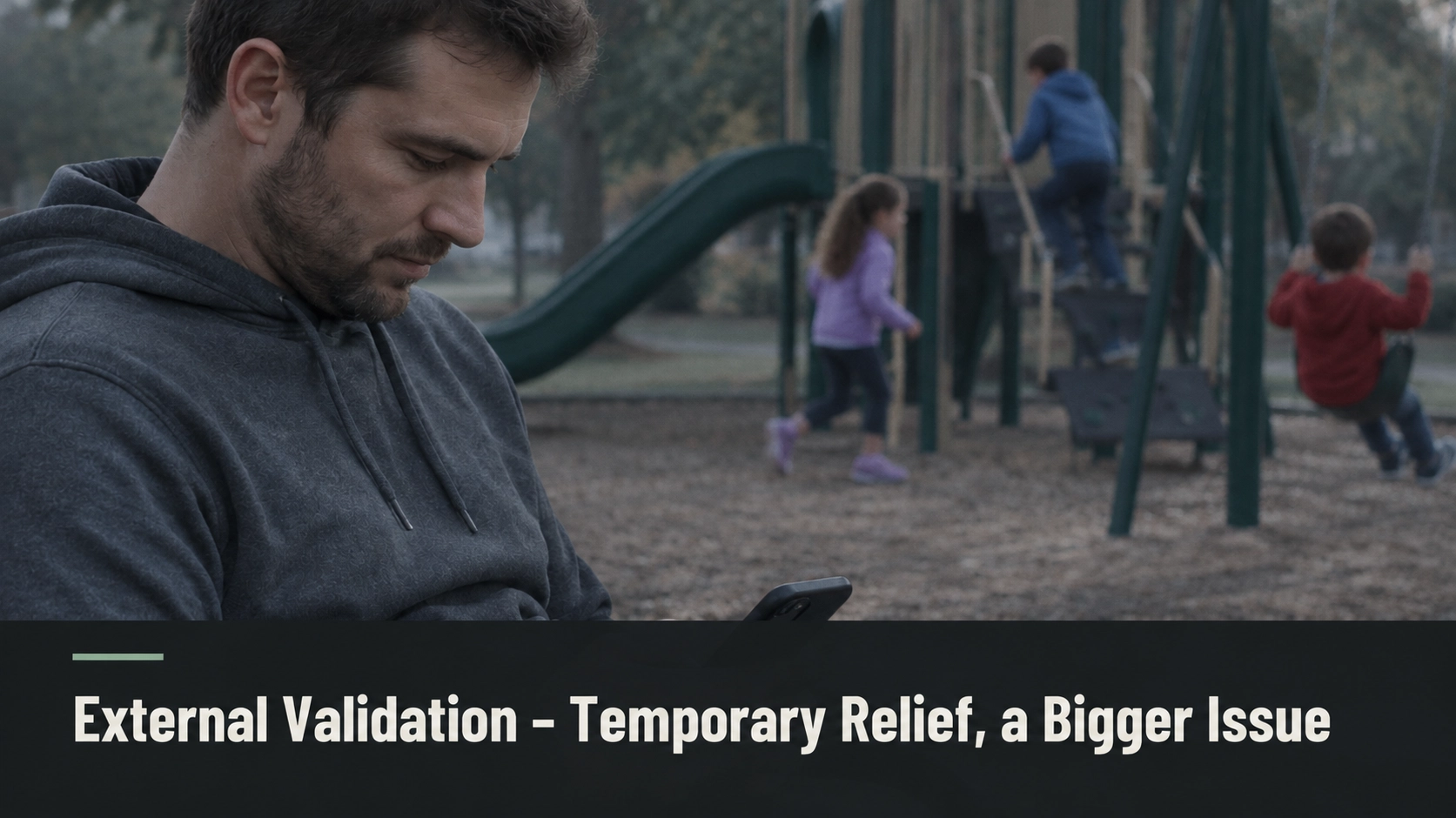
Why External Validation Never Feels Like Enough

There is a version of this that does not look like ambition at all. It looks like asking your partner whether you handled the conversation well. Replaying what you said in the meeting on the drive home. Reading a message three times before sending it, then reading it again after. Checking with someone, anyone, that you did not stuff it up.
Then there is the version that looks like success. You reach the target. The deal goes through, the business has a good month, or someone finally says they are proud of you. For a few days you feel settled. Then the feeling drains out and the next target starts calling.
Two very different-looking behaviours, one underlying question: am I okay?
Most men do not connect the two. They treat the checking as thoroughness and the drive as ambition. What they miss is that both are external validation, and both are doing the same job: trying to get rid of anxiety from the outside.
There is nothing wrong with caring about your work or enjoying recognition. The strain starts when those become the only places you can go to feel alright about yourself.
The relief is real, and it wears off
When you are already wound up, reassurance does something physical. The shoulders come down, the breath deepens, the mind stops circling for a minute. That is not imagined and it is not weakness. It is a nervous system taking the fastest route to safe.
The problem is the route. Relief that comes from outside has no floor under it, so it has to be topped up. You ask, you get the answer, you feel better, and then a few hours later the doubt comes back with a follow-up question. What if they were just being kind? What if I did not explain it properly? What if this time is actually different?
Every round of that trains the urge a little stronger.
What the system quietly learns
Run that loop often enough and the lesson underneath stops being about the specific worry. It becomes a rule: I cannot settle this on my own. I need someone else to tell me I am okay.
The rule is the problem, not the reassurance itself. Plenty of men never see it, because checking looks like being thorough, wanting a second opinion looks like being careful, and wanting to be liked looks like being a decent bloke.
The same engine with a bigger target
I know this from both sides. Set a goal. Work hard. Get the result. Feel the lift. Then, before long, the lift is gone and the next goal has to be bigger.
For a while, I thought I was chasing the number. The revenue, the next opportunity, the proof that the business was moving in the right direction. Looking back, I can see I was also chasing a feeling: that I was doing enough, that I was enough.
That’s why external validation can feel so thin. Praise, support and appreciation can matter. But if you’re relying on them to settle a deeper doubt about yourself, the relief may not last. The next result has to do the same job all over again.
The pattern has been studied as “contingencies of self-worth”: when a man’s self-worth depends heavily on outcomes like achievement or approval, those outcomes can leave it exposed to the next setback. A 2005 review, “Contingencies of Self-Worth”, discusses how those conditions shape the pursuit of self-esteem.
A setback can start to feel like a verdict
When your worth is tied to business results, a lost deal is more than lost income. It can feel like evidence that you’re not capable, not sharp enough, or not who you thought you were.
That’s when the panic can arrive. The problem on the table is real, but it has picked up a second meaning: What does this say about me?
I didn’t stop caring about results. I still care about doing good work and building things that matter. What changed was the role I asked those results to play. I stopped expecting them to tell me who I am.
That sounds like a small distinction. It changes what a man can sit through. A setback can still hurt and still cost money. But it doesn’t have to become a verdict on your whole character.

Where the pattern comes from
For a lot of men this makes complete sense once you look backwards. If approval was inconsistent growing up, or tied to performance, or given generously on the days you achieved and withheld on the days you did not, you learn early that safety is something you read off other people's faces and adapt yourself to.
That is a smart adaptation for a kid with no other options. It just does not age well. The man still scanning the room for a sign that he is okay is running a strategy built for a house he no longer lives in.
It also explains why letting go of validation can feel frightening rather than freeing, at least at first. If reassurance has been the thing that made the fear go down, taking it away without putting anything in its place is not freedom. It is exposure.
Why "just stop seeking reassurance" does not work
Plenty of men get told to stop asking, trust themselves more, back themselves. Well intentioned and useless, because it names the behaviour and removes the coping strategy in the same sentence without offering a replacement.
Validation is not the enemy. Men are relational. A mate who tells you straight that you handled it fine is worth having, and wanting that is not a defect. The question is narrower: is reassurance one part of how you steady yourself, or the main way you do it?
If it is the main way, the work is not to cut it out. It is to build something underneath it.
What actually helps
The men who shift this do not do it by deciding to need less. They do it in unglamorous ways:
noticing the urge to ask before acting on it, and letting the discomfort sit for ten minutes
practising being uncertain and doing nothing about it
working out where the pattern started, without using it as an excuse
learning to settle the body directly, because a nervous system in alarm cannot be reasoned with
being kinder to themselves than the running commentary in their head
None of that is a weekend job. It is a slow build, and it is the same build that produces self-trust.
Self-worth needs somewhere steadier to stand
Moving your self-worth away from results doesn’t mean pretending results don’t matter. It means keeping the result in its proper place.
A contract falls through. That is a business problem to deal with. It might mean a hard conversation, a change of plan or less money in the account. It does not, by itself, explain your worth as a man, a father, a partner or a mate.
This isn’t always easy to remember when the pressure is on. The mind can move fast from “That didn’t work” to “I’m not good enough”. The work is to notice when that second thought has joined the first, and not treat it as a fact just because it feels convincing.
You can’t wait for certainty before you settle
Most of what matters in life isn’t fully decided. Some things depend on other people. Some depend on timing. Some are simply outside your control.
If you need to know the outcome before you can feel calm, calm can keep getting pushed further away. There will always be another decision, another risk or another conversation you can’t control.
I haven’t found stillness by telling myself everything will work out. I don’t know that it will, and neither do you. What has helped me is something more solid: looking back at what I’ve already dealt with.
Some problems took years. Some cost me things I didn’t want to lose. A lot of it wasn’t smooth, quick or clever. But I found a way through each one.
That history matters. It doesn’t guarantee the next problem will be easy, or that I’ll get everything I want. It gives me a reason to believe I can meet what comes, work out the next move and ask for help where I need it. That’s different from predicting a perfect outcome.

Self-trust grows from things you actually do
When men ask how to build confidence, it’s tempting to look for the right feeling first. But self-trust is less about feeling sure and more about knowing, through experience, that you can rely on yourself.
Each time you tell yourself you’ll do something and follow through, you give yourself a small piece of evidence. Each time you keep putting it off, that evidence can feel harder to find.
That doesn’t mean you need to shame yourself for a missed gym session or an early alarm you slept through. Life gets in the way. Plans change. Discipline isn’t about keeping every promise perfectly. It’s about making commitments you can realistically keep, and returning to them when you drift.
The task itself may be ordinary: go for a walk, prepare tomorrow’s lunch, make the call you’ve been avoiding, or put your phone down at a set time. The task matters. But so does the fact that you chose it and followed through.
Try this today
Choose one promise that fits the day you actually have, not the day you wish you had. Make it small enough that you can keep it.
Be specific. “Look after myself” is hard to act on. “Walk around the block after lunch” gives you something you can do. At the end of the day, notice whether you kept the promise. No speech, no scorecard. Just notice.
Repeat it tomorrow if it still makes sense. Over time, small follow-through can make self-trust less of an idea and more of something you’ve experienced.
Let recognition in, but don’t make it your foundation
You don’t need to reject praise or act like success means nothing. It’s fine to enjoy a good result. It’s fine to take pride in being appreciated by someone whose opinion matters to you.
The point is to let those things add to your life without asking them to hold you together. External validation comes and goes with circumstances. The record you build through your own choices stays with you.
So what is one promise you have kept to yourself long enough that it stopped feeling like a decision?
Frequently asked questions
Why does achievement never feel like enough?
A win can bring real satisfaction, but it may not last if you’re also relying on it to prove your worth. When that feeling fades, another target can seem like the only way to get it back. It can help to notice what you hoped the achievement would make you feel about yourself.
How do I stop needing other people’s approval?
You don’t have to stop caring what people think. Start by noticing when you’re changing a decision mainly to avoid someone’s disapproval, then ask what you would choose if you could tolerate their disagreement. Practise making small choices you can stand behind.
What is self trust?
Self-trust is confidence built from your own experience of following through, adapting and dealing with what happens. It doesn’t mean believing you’ll never make a mistake. It means having some reason to believe you can respond when things don’t go to plan.
Can confidence be built if you have never had it?
Confidence can grow through experience, including ordinary moments of keeping a realistic commitment and handling setbacks. Start with something small enough to do consistently. You don’t need to feel confident before you begin.
Is seeking reassurance a form of anxiety?
Often, yes. Reassurance seeking is one of the more common ways anxiety shows up, because it settles the nervous system fast. It becomes a problem when it is the main way you manage doubt rather than one part of a wider set of ways.
Why do I need constant reassurance?
Reassurance settles anxiety quickly, so it becomes the fastest route to feeling safe and the loop trains itself. It usually points to a nervous system that has not yet learned it can tolerate doubt and disapproval without falling apart. Some men work on that with a therapist, and it can sit alongside a men's group rather than replacing it.
COREMEN™ is not a therapy service or a crisis service. For support, call Lifeline on 13 11 14 or 13YARN on 13 92 76; call 000 in an emergency.
